
Beta Pictoris d: James Webb Discovers a Hidden Giant Exoplanet
Astronomers using NASA’s James Webb Space Telescope have discovered Beta Pictoris d, a giant exoplanet hidden inside one of the brightest and most closely studied planetary systems near Earth.
The discovery is unusual because researchers did not initially confirm the planet by simply locating a clear point of light. Instead, Webb’s instruments detected the distinctive chemical fingerprint of its atmosphere within the glare and dust surrounding its host star.
Beta Pictoris d is now the third known giant planet orbiting Beta Pictoris. Its discovery also makes Beta Pictoris only the second planetary system known to contain at least three planets that have been imaged.
Beta Pictoris d at a glance
Detail | Current information |
|---|---|
Planet name | Beta Pictoris d |
Planet type | Gas giant |
Distance from Earth | Approximately 63 light-years |
Estimated mass | About 2–2.4 times Jupiter’s mass |
Estimated orbital distance | Roughly 26–30 astronomical units |
Estimated orbital period | About 91 years |
Host star’s age | Approximately 23 million years |
Main discovery instrument | James Webb’s NIRSpec |
Molecules detected | Carbon monoxide, water vapour and methane |
Discovery announced | 2026 |
NASA’s current exoplanet catalogue lists Beta Pictoris d at approximately 2.4 Jupiter masses, with an orbital distance of 26 astronomical units and an orbital period of about 91 years. The discovery team’s initial modelling placed it at approximately 30 astronomical units and at least twice Jupiter’s mass. These figures may become more precise as researchers collect additional observations.
What is Beta Pictoris d?
Beta Pictoris d is a young gas-giant planet orbiting the star Beta Pictoris.
The system is located approximately 63 light-years from Earth and is only around 23 million years old. By comparison, our Solar System formed approximately 4.6 billion years ago.
Because Beta Pictoris is still so young, it provides astronomers with an opportunity to examine a planetary system while its planets, dust and debris are still evolving.
The star was already known to host two giant planets:
- Beta Pictoris b, one of the earliest exoplanets to be directly imaged
- Beta Pictoris c, a massive planet orbiting closer to the star
- Beta Pictoris d, the newly identified planet with the widest known orbit of the three
Beta Pictoris d remains inside the inner edge of the system’s large debris disk, despite orbiting farther from its star than planets b and c.
How did James Webb discover Beta Pictoris d?
The researchers were not originally searching for a new planet.
They were using Webb’s Near-Infrared Spectrograph, better known as NIRSpec, to study the atmosphere of the already-known planet Beta Pictoris b.
NIRSpec’s Integral Field Unit can collect both an image and a spectrum from different points within an observed region. A spectrum separates light into wavelengths, allowing researchers to identify chemical signatures produced by molecules.
During their analysis, the team noticed an unexpected pattern where they had expected to see a relatively smooth spectrum from light scattered by dust.
The signal contained a recognisable pattern of carbon monoxide absorption lines. Its position and movement also matched an object orbiting Beta Pictoris rather than a distant background star or brown dwarf.
This evidence allowed the researchers to determine that the source was another planet.
Webb detected the planet through its atmospheric fingerprint
Traditional direct imaging generally attempts to separate a planet’s light from the much brighter light of its host star.
That approach becomes especially difficult in the Beta Pictoris system because the star is surrounded by a bright debris disk. Dust within the disk scatters starlight and creates structures that can resemble faint planetary objects.
Researchers therefore could not rely on an unexplained bright spot alone.
Instead, they examined the object’s spectrum. The carbon monoxide signature acted as evidence that the light was passing through or emerging from a giant planetary atmosphere.
Follow-up observations using Webb’s Mid-Infrared Instrument, or MIRI, detected additional signs of water vapour and methane. These observations further supported the conclusion that the object was a planet and provided initial information about its atmospheric composition.
Why did the planet remain hidden for so long?
Beta Pictoris has one of the brightest known debris disks.
The large amount of dust surrounding the star produces scattered light that can obscure faint planets or cause parts of the disk to appear planet-like. This makes it difficult to distinguish a genuine planet from dust structures, image-processing effects or instrumental artefacts.
Spectroscopy helped researchers look beyond that visual confusion. Instead of asking only whether an object appeared as a bright dot, they searched for narrow molecular signatures associated with an atmosphere.
This allowed the team to isolate Beta Pictoris d from the surrounding “cosmic fog.”
What do scientists know about Beta Pictoris d?
Beta Pictoris d is currently classified as a gas giant.
NASA’s exoplanet catalogue estimates that it has:
- A mass around 2.4 times that of Jupiter
- A radius approximately 1.26 times Jupiter’s radius
- An orbital distance of about 26 astronomical units
- An orbital period of approximately 91 years
One astronomical unit is the average distance between Earth and the Sun. An orbit of 26–30 astronomical units places Beta Pictoris d at a distance broadly comparable to the outer region of our Solar System.
However, these values are still estimates. Researchers plan to continue analysing Webb observations to improve their understanding of the planet’s orbit, temperature and atmospheric composition.
What is in the atmosphere of Beta Pictoris d?
Current Webb observations have identified evidence associated with:
- Carbon monoxide
- Water vapour
- Methane
The initial NIRSpec detection relied heavily on carbon monoxide absorption lines. Follow-up MIRI observations added evidence of water vapour and methane.
Detecting these molecules does not mean the planet supports life. All three can exist naturally in the atmospheres of young gas giants.
Instead, their presence helps scientists estimate the planet’s temperature, chemistry, atmospheric structure and possible formation history.
Why is the discovery scientifically important?
The importance of Beta Pictoris d extends beyond adding another planet to an exoplanet catalogue.
1. It demonstrates a different way to find planets
Beta Pictoris d is described by NASA as the first directly imaged planet discovered primarily through moderate-resolution spectroscopy.
Researchers identified the planet by detecting its atmospheric molecules instead of relying exclusively on conventional imaging. This approach could help astronomers locate planets hidden within bright disks or other visually complicated environments.
2. The planet may explain the shape of the debris disk
Astronomers had previously suggested that an unseen planet might be influencing the unusual structure of the Beta Pictoris debris disk.
Beta Pictoris d could help explain features such as the disk’s sharply defined inner edge. Its gravity may be shaping the movement and distribution of dust and smaller objects around the star.
3. It provides a view of a young planetary system
Beta Pictoris is still in an early stage of its development.
Studying its three giant planets and surrounding debris may help scientists understand how large planets form, migrate and interact with the material left over after planetary formation.
4. The atmosphere was studied from the beginning
Ordinarily, detecting a planet and analysing its atmosphere can require separate observation programmes.
In this case, the spectroscopic information that revealed the planet also provided evidence about its chemistry and motion. Researchers began characterising the atmosphere as part of the discovery itself.
Beta Pictoris b, c and d compared
Planet | Relative position | Key characteristic |
|---|---|---|
Beta Pictoris c | Closest of the three to the star | Massive inner giant planet |
Beta Pictoris b | Between c and d | One of the earliest directly imaged exoplanets |
Beta Pictoris d | Farthest known planet in the system | Discovered primarily through atmospheric spectroscopy |
The three planets give astronomers several objects at different orbital distances within the same young system. Comparing them may reveal whether they formed from similar material and how their atmospheres and orbits changed over time.
Is Beta Pictoris d habitable?
Beta Pictoris d is not considered a likely Earth-like habitable world.
It is a massive gas giant with no known solid surface, and the entire Beta Pictoris system is extremely young. The discovery of water vapour or methane in its atmosphere should not be interpreted as evidence of life.
The planet is scientifically valuable because it helps researchers study giant-planet formation and atmospheric chemistry, not because it currently appears suitable for humans or Earth-like organisms.
Could Webb find more hidden planets this way?
The discovery demonstrates that spectroscopy may reveal planets in locations where ordinary imaging struggles.
A planet hidden by dust, glare or complex structures may still produce a recognisable molecular pattern. Researchers can then use the object’s spectrum and motion to test whether it is genuinely orbiting the star.
This does not mean every spectroscopic signal will reveal a planet. Observations must still rule out instrumental effects, background objects and non-planetary structures.
However, Beta Pictoris d provides evidence that atmospheric fingerprinting can become an important addition to existing exoplanet-detection methods.
Frequently asked questions
What is Beta Pictoris d?
Beta Pictoris d is a young gas-giant exoplanet orbiting the star Beta Pictoris approximately 63 light-years from Earth.
Who discovered Beta Pictoris d?
A research team analysing observations from NASA’s James Webb Space Telescope identified the planet. The discovery study was led by Aidan Gibbs of the University of California, San Diego.
How was Beta Pictoris d discovered?
The planet was discovered primarily through spectroscopy. Webb’s NIRSpec instrument detected carbon monoxide absorption associated with its atmosphere, while later MIRI observations found evidence of water vapour and methane.
How large is Beta Pictoris d?
NASA’s exoplanet catalogue currently lists the planet at approximately 2.4 times Jupiter’s mass and 1.26 times Jupiter’s radius.
How long does Beta Pictoris d take to orbit its star?
NASA’s current catalogue estimate gives Beta Pictoris d an orbital period of approximately 91 years.
Why was Beta Pictoris d difficult to find?
The planet lies within a bright debris disk that scatters the star’s light. That scattered light made it difficult to distinguish the planet from surrounding dust structures using conventional imaging alone.
Is the published image an actual photograph of the planet?
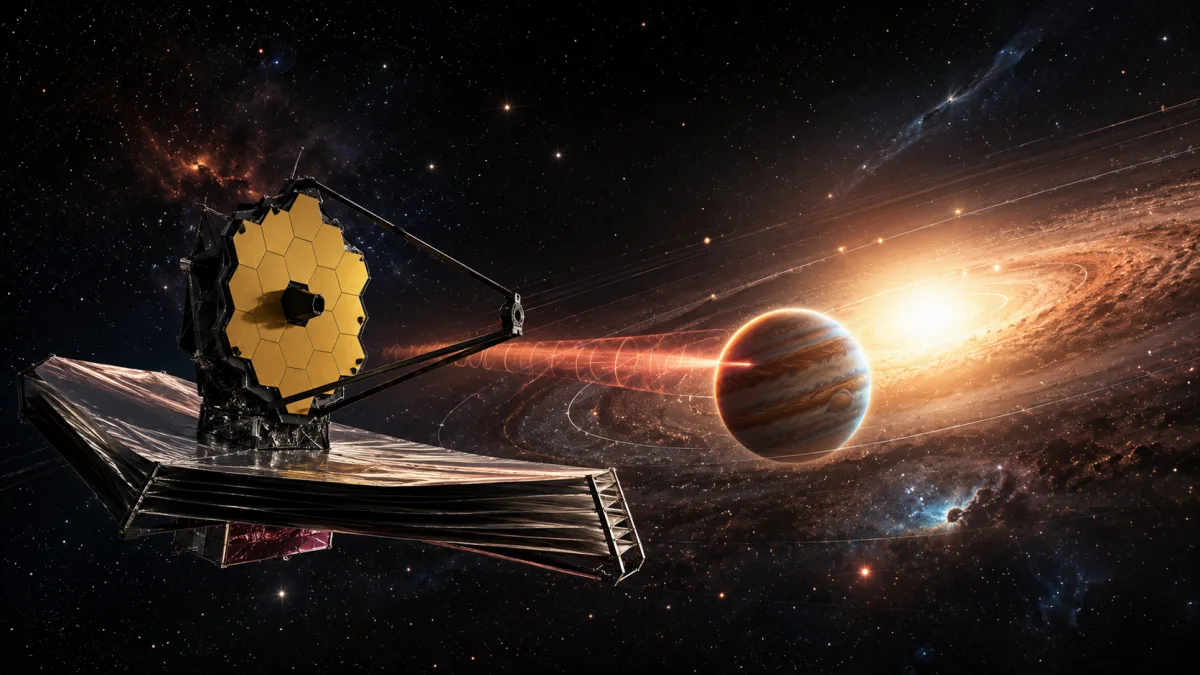
NASA has released reconstructed Webb observations in which Beta Pictoris d appears as a detected source. Many colourful images used in news coverage are artist illustrations and should be labelled clearly as such.
What happens next?
Researchers plan to continue studying Beta Pictoris d to refine estimates of its temperature, atmosphere and orbit.
Future observations may also show how the planet interacts with the surrounding debris disk and whether its gravity is responsible for some of the disk’s unexplained structures.
Because Beta Pictoris is young, nearby and already home to three imaged planets, it is likely to remain an important natural laboratory for studying how planetary systems form and evolve.
Final takeaway
Beta Pictoris d was hiding in one of astronomy’s most frequently observed young planetary systems.
James Webb revealed it not merely as a faint point of light, but through molecular signatures within its atmosphere. That distinction makes the discovery especially important: astronomers were able to identify a planet, confirm its motion and begin studying its chemistry using the same spectroscopic observations.
The result adds a third known giant planet to the Beta Pictoris system and provides researchers with a promising new method for finding worlds concealed by dust and stellar glare.
Sources:
NASA Science — NASA’s Webb Discovers Hidden Planet in Famous Star System
NASA Exoplanet Catalog — Beta Pictoris d